

This item is part of our special edition”Buddhist Education in Latin America and Spain”
We are pleased to announce the opening of registrations for the third 2021 edition of the course! “Mahāyāna Buddhism and its expansion in East Asia”! Organized by the Rovira i Virgili University Foundation and the Dharma-Gaia Foundation, this program responds to the resounding success of previous editions — the last one in 2024, which attracted more than 80 participants from all over the Spanish-speaking world and received excellent reviews. Conceived as an innovative online course, it will be held from September 28 to December 17, 2026 and is specifically designed for the global Spanish-speaking community.

We offer a flexible modality: join live sessions or access full recordings throughout the course, adapting to your schedule and time zone. Find out more about this high-quality program, which combines academic rigor with experiential practices.
Buddhist teachings have transcended borders and millennia, influencing contemporary philosophy, psychology and art. However, in Spanish-speaking countries, it remains a treasure to be discovered in academic environments. To address this gap, FURV and FDG forged an agreement in 2021 that has generated innovative educational courses, publications and events.
This course is part of the training program”Buddhism and its traditions: from its origins to its modern interpretations”, an academic itinerary structured in four modules that can be taken completely or completely independently. The module that is now being presented is dedicated to Mahāyāna Buddhism. It is preceded by the module on early Buddhism and will be followed by the module on Tantric Buddhism and Vajrayāna and a fourth module dedicated to modern Buddhism, focusing on its contemporary reformulations and its dialogue with science, psychology, and various spheres of social life. This progressive structure allows us to obtain a panoramic view of the Buddhist phenomenon and, at the same time, to delve into each of its main historical trends.
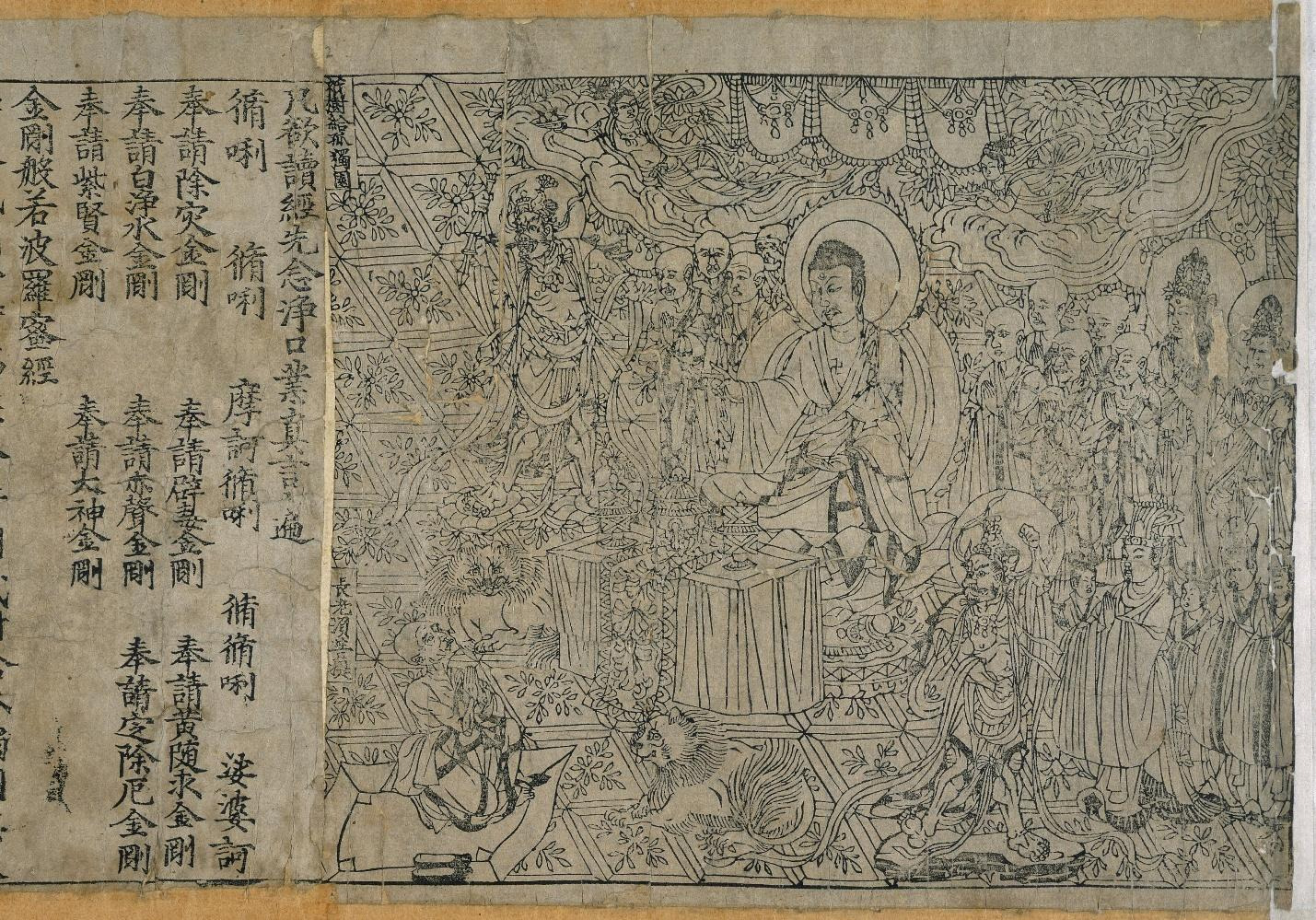
Description of the course “Mahāyāna Buddhism and its expansion into East Asia”
This theoretical-practical course offers a rigorous and panoramic view of Mahāyāna Buddhism and its expansion into East Asia. It begins with the historical and philosophical development of Buddhism in India after the Buddha's parinirvāṇa, delving into the evolution, teachings, practices and characteristics of the Mahāyāna tradition. Fundamental issues are explored, such as the controversies surrounding its origins, the ideal of the bodhisattva and its path, Buddhahood, the Buddhahood, the doctrine of the three bodies of the Buddha —trikāya— and the tathāgatagarbha. Pure Land Buddhism and the Madhyamaka and Yogācāra schools are also studied, as well as the concept of prajñāpāramitā, the devotional and artistic expressions of mahāyāna and its expansion to Central Asia and China.
The second part focuses on Chinese Buddhism, examining its interaction with local culture and spirituality, as well as its essential texts and main doctrinal currents. The Tiantai, Huayan, Pure Land and Chan schools are analyzed, highlighting their contribution to Buddhist thought inside and outside China. This block includes a practical chan meditation workshop, offering an experiential experience guided by an authorized instructor of this lineage. It also addresses the evolution of Buddhism in China from the Ming and Qing dynasties to the development of humanist Buddhism, providing a vision of its transformation and current relevance.
The third section addresses the trajectory of Buddhism in Japan since its introduction, highlighting its interaction with Confucianism and Shinto, as well as its development from the Nara era to the post-war period. It reviews the formation of the six schools of Nara, the influence of the Tendai and Shingon schools during the Heian era, and the emergence of new forms of popular Buddhism in the Kamakura era, with schools such as Jōdo Shinshū, Sōtō, Rinzai, Nichiren and Ji. Also noteworthy are the strengthening of Zen during the Muromachi era, the evolution of Buddhism in the Edo era, the influence of figures such as Hakuin Ekaku, the crisis caused by haibutsu Kishaku in the Meiji era and the changes produced during the Pacific War and the post-war period. The course concludes with a reflection on the projection of Mahāyāna Buddhism in East Asia and its contemporary relevance.
Language and scope: in Spanish, aimed at students and interested general public.
Duration: 60 teaching hours (6 ECTS credits), with 5 hours per week over two days via Moodle (URV).
Dates and times: From September 28 to December 17, 2026. Sessions from 16:00 to 18:30 (Spanish time), ideal for Latin America. All engraved.
Location: Virtual Campus (Moodle). 100% online format with video conferencing.
Enrollment: Limited to 70 places in order of registration. Cost: 180€.
Sign up here!
Admission requirements: High school level exceeded.
Certification requirements: 70% online attendance + an essay of about 2000 words to be submitted at the end of the course.
Certificate of achievement.
A certificate will also be issued for individuals who complete the four-course series.
Objectives:
Learn about the history and cultural context of Buddhism.
Learn philosophical, doctrinal and practical foundations of Mahāyāna in East Asia.
Experience the basics of Mahāyāna meditation.
Academic direction:
Jaume Vallverdú and
Daniel Millet Gil.
Teachers of the Mahāyāna Buddhism course
The course has a teaching team specialized in Asian religions, Buddhism, Chinese culture and Japanese studies. Participants include Agustí Pàniker Vilaplana, María Elvira Ríos Peñafiel and Gustavo Pita Céspedes, with extensive academic, research and educational careers.

Agustí Pàniker Vilaplana (Barcelona, 1959): Director of the Kairós publishing house, essayist, lecturer and scholar of India and world religions. Professor in university master's degrees such as Religions and Societies (Pablo Olavide University), History of Religions (UAB-UB), Asia-Pacific Studies (UB) and Immigration and Intercultural Education (UB). Author of books such as Jainism (2001), Índika (2005), The Sikhs (2007), Shitala's dream (2011), Caste society (2014) and The Three Jewels (2018). He has published numerous articles on societies, religious traditions and global cultures.

María Elvira Ríos Peñafiel (Santiago, Chile, 1980): Master and PhD in Asian and African Studies (specialization in China) from El Colegio de México (2015), a student of Professor Luis Óscar Gómez. He has published research on Buddhism and Chinese culture in academic journals. Coordinator of New dialogues: Asia and Africa from a Latin American perspective (2019). She advises on Chinese educational projects in Chile (2015-2018), researcher at Santo Tomás University (2018) and teacher of Buddhist courses in Latin America. Postdoctoral fellow at the Pontifical Catholic University of Chile with research on ecology in Chinese Buddhism. She is currently an adjunct researcher at the ICLAC Millennium Center (Catholic University of Chile), professor at the Dharma-Gaia Foundation and member of RIEB, ALADAA Chile and LEB.

Gustavo Pita Céspedes (Havana, Cuba, 1959): Master in Philosophy from Leningrad State University (1983). Professor of History of Philosophy at the Instituto Superior de Arte de Cuba (1987-2004). Master in Asian and African Studies from El Colegio de México (2006) and doctorate in Translation and Intercultural Studies from the UAB (2013). Research stays in Japan (Hanazono University, 1993-1994; University of Tsukuba, 2007-2008) as a Japan Foundation Fellow. He is currently a professor in the Department of East Asian Studies at the UAB. Author of Genealogy and transformation of the Bushi culture in Japan (2014), articles on Japanese philosophy and culture, and translations of Japanese literature into Spanish.
MAHĀYĀNA BUDDHISM COURSE SCHEDULE AND PROGRAM
September—December 2026
24 sessions/60 teaching hours — Schedule: 4:00 p.m. to 6:30 p.m.
No. 1
Date: September 28
Thematic: Introduction. Bibliographic recommendations. Origins of Mahāyāna. Three vehicles.
Professor: Agustí Pàniker Vilaplana
No. 2
Date: October 1
Thematic: Recapitulation of early Buddhism. Conception of the Buddha. First Councils. Buddhism with the Mauryas. Nikaya or early Buddhism.
Professor: Agustí Pàniker Vilaplana
No. 3
Date: October 5
Thematic: Major expansion in India. New developments in Mahāyāna. Central Asia. The “canon” of Mahāyāna.
Professor: Agustí Pàniker Vilaplana
No. 4
Date: October 8
Thematic: 1st Noble Truth: Duhkha, Anitya. 2nd Noble Truth: Trishna, Avidya. Anatman, Skandhas, Pratitya-samutpada, Shunyata.
Professor: Agustí Pàniker Vilaplana
No. 5
Date: October 13
Thematic: Karma, Samsara. Cosmology. 3rd Noble Truth: Nirvana. Buddhahood.
Professor: Agustí Pàniker Vilaplana
No. 6
Date: October 15
Thematic: 4th Noble Truth: Praxis. Ideal Bodhisattva (Bodhichitta, Paramitas). Wisdom and Compassion.
Professor: Agustí Pàniker Vilaplana
No. 7
Date: October 20
Thematic: Philosophies of Mahāyāna. Prajñaparamita. Madhyamika. Yogachara. Tathagatagarbha. Huayan.
Professor: Agustí Pàniker Vilaplana
No. 8
Date: October 22nd
Thematic: Art and iconography. Mythology. Devotional Buddhism.
Professor: Agustí Pàniker Vilaplana
No. 9
Date: October 27
Thematic: Historical introduction. Buddhism on its way to East Asia. The Dunhuang Caves: artistic and doctrinal manifestations.
Professor: María Elvira Ríos Peñafiel
No. 10
Date: October 29
Thematic: Historical cultural and religious context of ancient China.
Professor: María Elvira Ríos Peñafiel
No. 11
Date: November 3
Thematic: Tiantai School: Doctrine and Teachers. Excerpts from Lotus Sutra.
Professor: María Elvira Ríos Peñafiel
No. 12
Date: November 5
Thematic: Huayan School: Doctrine and Teachers. Excerpts from Sutra Avatashaka.
Professor: María Elvira Ríos Peñafiel
No. 13
Date: November 10
Thematic: Pure Land School: Doctrine and Teachers. Extracts Sutra Sukhāvatīvyuha.
María Elvira Ríos Peñafiel
No. 14
Date: November 12
Profession: Thematic: Chan I School: Doctrine and Teachers. Excerpts from the Sūtra Prajñāpāramitāhṛdaya.
María Elvira Ríos Peñafiel
No. 15
Date: November 17
Thematic: Local beliefs: deities, sacred mountains and pilgrimages. Chan Meditation: Master Chang Wu, Fagushan, Vancouver.
Professor: María Elvira Ríos Peñafiel
No. 16
Date: November 19
Thematic: Road to Modern Buddhism: Ming-Qing and Humanist Buddhism.
Professor: María Elvira Ríos Peñafiel
No. 17
Date: November 24
Thematic: Introduction of Buddhism in Japan. The interaction between Buddhism, Confucianism and Shinto as a premise. Buddhism in the Nara era (710-784). The six schools of Nara (Nanto Rokushū): Sanron, Jōjitsu, Hossō, Kusha, Kegon, Risshū. Buddhism in the Heian era (I). The Tendai and Shingon schools.
Professor: Gustavo Pita Céspedes
No. 18
Date: November 26th
Thematic: Buddhism in the Heian era (2). Mountain Buddhism (sangaku bukkyō). Japan's indigenous mountain beliefs (sangaku shinkō) and mountain Buddhism. The Shugendō and the Yamabushi.
Professor: Gustavo Pita Céspedes
No. 19
Date: December 1
Thematic: Buddhism in the Kamakura era (1185-1333). The new popular Buddhism. The Jōdoshinshū school founded by Shinran (1173-1262). The Sōtōshū school of Zen Buddhism founded by Dōgen (1200-1253). The Rinzaishū school of Zen Buddhism founded by Eisai. The Nichirenshū school founded by Nichiren (1222-1282). The Jishū (Yugyō) school founded by Ippen (1239-1289).
Professor: Gustavo Pita Céspedes
No. 20
Date: December 3
Thematic: Buddhism in the Muromachi era (1336-1574). The Jōdoshinshū school in the Muromachi era. Zen Buddhism of the Rinzaishū school in the five great Buddhist monasteries (gosan) of Kyoto and Kamakura. Rennyo's work at the Honganji temple. The arrival of Christianity in Japan (1549).
Professor: Gustavo Pita Céspedes
No. 21
Date: December 9th
Thematic: Buddhism in the Edo era (1603-1867) (1). The Tendaishū school in the Edo era. Tenkai (1536-1643). The Zen Buddhism of the Rinzaishū school in Takuan Sōhō (1573-1645). The Ōbakushū school of Zen Buddhism founded by Ingen [ch. Yinyuan] (1592-1673) in 1661. The Zen Buddhism of the Rinzaishū school of Hakuin Ekaku (1686-1769) and his disciple Torei Enji (1721-1792). The Jōdoshinshū school: the division of Honganji into Nishi-Honganji and Higashi-Honganji in 1602.
Professor: Gustavo Pita Céspedes
No. 22
Date: December 10
Thematic: Zen Buddhism in the Edo era (2). The Buddhism of the Shingonshū school in the Edo era. Jōdoshū Buddhism in the Edo era. The Zen Buddhism of the Rinzaishū school of Hakuin Ekaku (1686-1769) and his disciple Torei Enji (1721-1792). The Jōdoshinshū school: the division of Honganji into Nishi-Honganji and Higashi-Honganji in 1602.
Professor: Gustavo Pita Céspedes
No. 23
Date: December 15
Thematic: Buddhism in the Meiji era (1868-1912). The destruction of Buddhist culture under the haibutsu kishaku principle (abolishing Buddhism and rejecting Shakyamuni's teaching). The Zen Buddhism of the Rinzai Zen school in Nishida Kitarō (1870-1945) and Suzuki Daisetsu (1870-1966).
Professor: Gustavo Pita Céspedes
No. 24
Date: December 17
Thematic: Japanese Buddhism during the Pacific War (1941-1945) and in the post-war period. Buddhism and the Kyoto School. The Zen Buddhism of the Rinzaishū school in Hisamatsu Shin-ichi (1889-1980) and Nishitani Keiji (1900-1990). The formation of new schools of Buddhism in the 20th century. Buddhism in Korea and Southeast Asia.
Professor: Gustavo Pita Céspedes
Throughout the course, students will study the historical, doctrinal and practical evolution of Mahāyāna Buddhism from India to Japan, with special attention to its adaptation in China and East Asia.
Information and contact: Visit the URV Foundation website or contact Gemma Papio – gemma.papio@fundacio.urv.cat
Don't wait! Places are limited. Sign up today and join this journey of spiritual and academic discovery. Namaste! 🙏
Useful links:
Video presentation of the Universitat Rovira i Virgili 2020
Catalan Buddhist Film Festival
Articles published in Buddhistdoor in Spanish By or about course teachers
”Interview with Agustín Pániker, director of Editorial Kairós” by Daniel Millet.
”An Ecosophical Interpretation of the Buddhist Experience of Ganying” by María Elvira Ríos.
”The God of Stranger: Buddha in Chilean Magazines of the Early 20th Century” by Elvira Ríos.
”Fascinating and auspicious Buddhist devices: the NIANFOJI” by María Elvira Ríos.
Other related articles published on Buddhistdoor in Spanish
”The situation of Buddhist studies in Spain: educational programs” by Juan Arnau Navarro, Montse Castellà Olivé, Francisco Díez de Velasco, Ricardo Guerrero Diáñez, Basili Llorca Martínez, Daniel Millet, Agustín Pániker Vilaplana, Aleix Ruiz Falqués, Jaume Vallverdú Vallverdú, Abraham Vélez de Cea.
Buddhist Studies in Latin America and Spain (Volume I), edited by Daniel Millet Gil and Jaume Vallverdú Vallverdú. This first volume brings together a series of essays that explore the relationship between Buddhism and Spanish-American culture, addressing issues such as the reception of Buddhism in Latin America and Spain, the translations of Buddhist texts into Spanish and the impact of Buddhism on contemporary societies.
Buddhist Studies in Latin America and Spain (Volume II), edited by Daniel Millet Gil and Jaume Vallverdú Vallverdú. The second volume expands the focus of the first, including contributions that analyze Buddhism from interdisciplinary and regional perspectives, with an emphasis on its interaction with local cultural traditions and its impact on the academic environment.
Both volumes are available in PDF format and can be downloaded free of charge through the following links First volume and Second volume


