

It took time for animated films in Japan to capture an international adult audience. If already in the eighties we found surprising titles such as Angel's Egg or Akira, the discovery did not end up taking place until the beginning of the 21st century. In particular, in that Annus Mirabilis of 2001 that would bequeath us two peaks of the genre in Japan: the definitive phantasmagoria of Studio Ghibli, Chihiro's Journey, and the narrative kaleidoscope of Millennium Actress. Chihiro, in addition to being the highest-grossing film in Japan for almost two decades, brought Japanese animation its first Oscar and its only Golden Bear (Berlin Film Festival). It is still debated whether these works established a genuine school or if they were a glimpse of what anime could have been like with other audiences and influences, meteorites fallen from a better planet. The truth is that in the years immediately following, experiments take place that seem to be taking the baton. There we have the dense Ghost in the Shell 2: Innocence (2004) or the dreamlike Paprika (2006), although the film we are about to review is a Rare Avis even in this era of unbridled creativity, when deciding on a format that few associate with Japanese animation: stop-motion.
Kihachirō Kawamoto is considered the master of stop-motion Japanese man of his time, heir to techniques that never came to fruition in a country that prefers the eyes of permanent surprise of the manga anime. After the death of Osamu Tezuka in 1989, Kawamoto was appointed president of the Japan Animators Association, a position he held for life and that made it easier for him to orchestrate in 2003 a collaborative project of 35 animators inspired by a work (in turn collaborative) by the poet Bashō (Winter Days). His first feature film, Rennyo and his mother (1981), an unfindable filmed puppet theater, was dedicated to the patriarch Jōdo Rennyo. A few years later he was in charge of the puppets for a well-known television adaptation of Romance of the Three Kingdoms, and in the nineties of Sing by Heike. In 2005, he returned to Buddhist themes in his second and last feature film, adapting a novel by Shinobu Orikuchi based on the legend of Maṇadala (Hensōzu) from Taima (8th century).
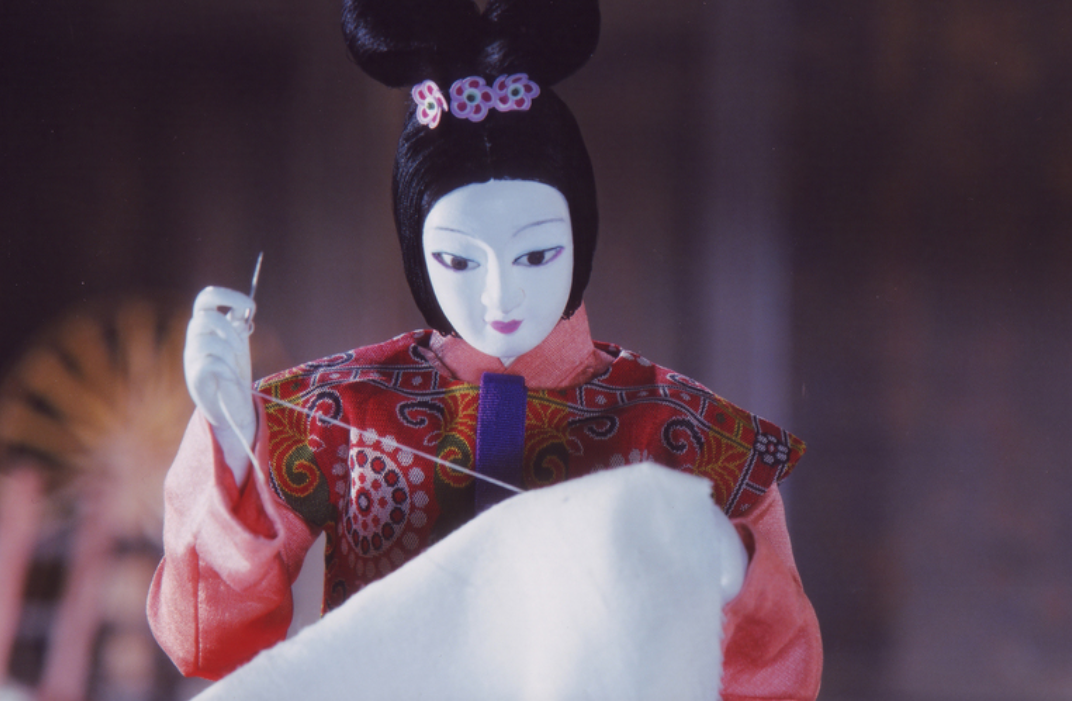
The Book of the Dead is inspired by the life of the popular heroine Chūjō-hime, who has been the source of legends and fictions over the centuries. Called here simply Iratsume (maiden), the protagonist spends her days locked behind a thick wall that protects her from men and evil spirits, studying and copying sutras, initially opposed by the women of the house, who considered studying a plebeian activity. It is proposed to make a thousand copies of an Amitābha sutra sent to her by an absent father, a task that she spends day and night. Immersed in her work-contemplation of the Buddha Amitābha, she begins to see a heavenly figure among the twin peaks of Mount Futakami; after completing the thousandth copy, she sets out to search. A storyteller will explain that the form he perceives is the spirit of Prince Ōtsu, who since his execution in the previous century wanders like a specter around the world.
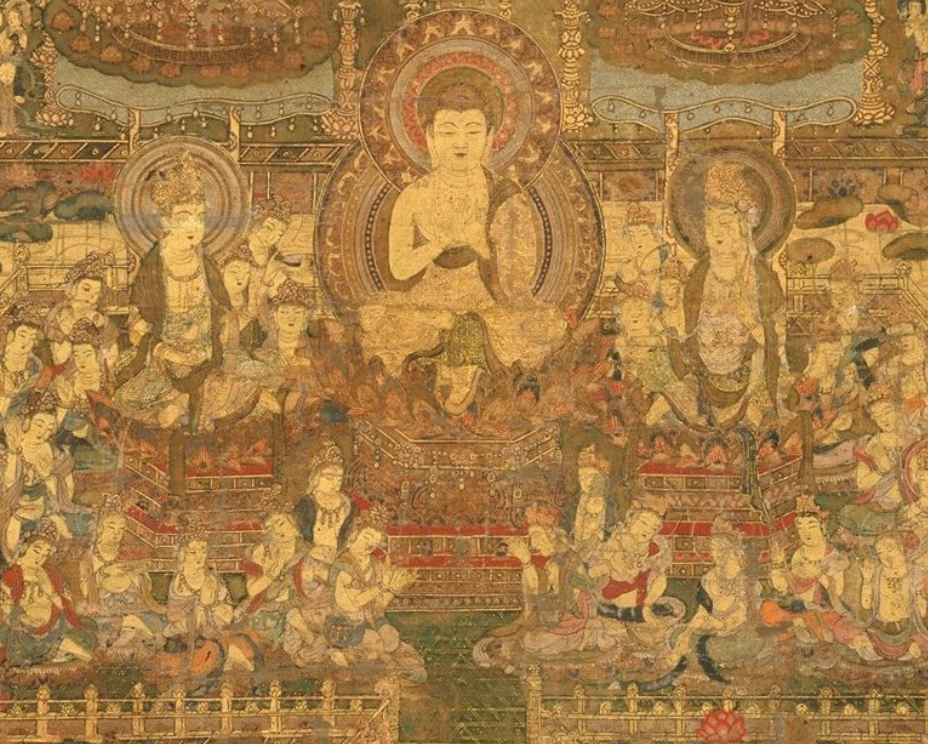
The plot progresses slowly —Shita, Shita— by detailed landscapes, sometimes laid out, sometimes drawn. This is one of those strange and meandering films from Japan, situated somewhere between folklore and narrative restlessness Nuberu Bagu, making use of a format (stop-motion analog with puppets) endangered. The rhythm and aesthetics are reminiscent of the author's shorts from the seventies and are aligned with the “indigenist” faction of Japanese celluloid; of course, they are closer to pre-modern arts such as Bunraku than to the frenetic pace of a lot of anime, so indebted to Superman. Everything has the quality of a folk tale, a Monogatari which could have been represented in a similar way at the time in which it is set and which, under its deceptive simplicity, leaves loose ends and entire subplots.
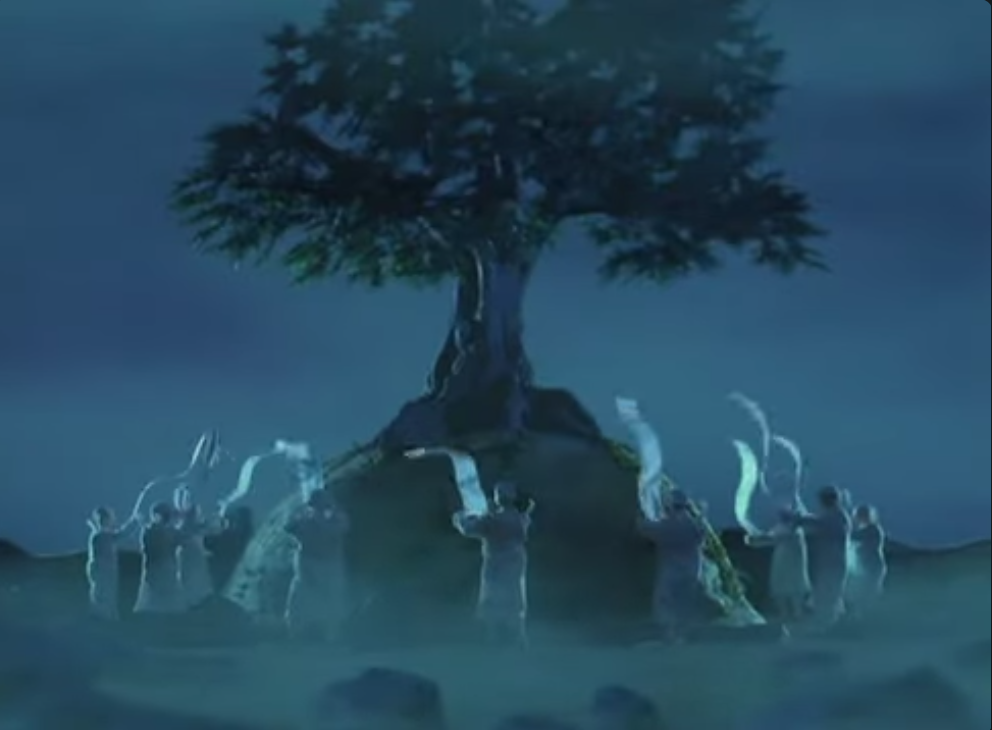
The story at hand is an unexpected window into classical Japanese Buddhism. At the time, Buddhism was a new tradition in the archipelago, introduced from China, but it had already been incorporated into Establishment cultural and political, and it had many of the characteristics that we know today. Anyone who only handles the refined version of some books on Zen will be surprised to discern, in this film, the fine fabric of Buddhism and the native Japanese religion, which we call Shinto and which until the 19th century formed a kind of official synthesis with Buddhism (Shinbutsu-shūgō). The veneration of the mountain, the references to the sanctuary of Ise, the kamis (Sinto deities) who are confused with humans... The recitation of Buddhist formulas reveals a powerful protection against spirits, and it is a Buddhist priest who demands spiritual cleansing from Iratsume for entering a tabulated area.
Like so many stories from East Asia, The Book of the Dead manages to be both a Buddhist fable and a ghost story, which is the favorite genre of Japanese fantasy, and one that is conspicuously absent in ancient India (although Indian Buddhism, in its Petavatthu, could foreshadow this alloy of terror and moral). In part, the popularity achieved by the cult of the Buddha Amitābha (Amida, in Japanese) responded, both in China and in Japan, to concern for the wandering spirits of deceased people, who, thanks to Amitābha's unsurpassed vows, could be redirected to Awakening. New techniques for dealing with the ghostly world that were superimposed on the old belief system, paving the way for a certain supremacy of Buddhism in the spiritual amalgam of East Asia (with regard to questions of life and death). In the film, we clearly see this triumphant superposition of Buddha on ghosts.
Beyond historical cinema and its clothing, some moments are reminiscent of other modern Japanese fictions, from Mishima to Ōshima: the erotic dissociation between the body (corpse) and the ghost, the blurring of religious yearning and desire, the healing will of a film Dedicated to the innocents who died in wars... One thing that strikes us is that, in Buddha's visions, the appearance of the figure corresponds more to the art of Gandhāra than to traditional Japanese Buddhas. We know that this ancient Buddhist land has entertained Japanese academia more than that of other countries, and that it survives in the collection associated with the popular Chinese novel Journey to the West (16th century). But maybe it's the series based on this novel, Monkey (1978-1980), and its Credits song which brought Gandhāra back to the popular Japanese imagination. This correlation between knowledge and the west is key to understanding the cosmography of the Buddhist-influenced cultures of China, Japan and other parts of the Far East of Eurasia: when he leaves his palace in search of the apparition, Iratsume heads west, in the direction of the sacred mountain Futakami, but also, much further away, from the Indian cradle of Buddhism, the repository of wisdom that was Gandhāra, and, even further, from the Pure Land of the Buddha Amitābha, who calls us.
Infinitely far... and infinitely close, thanks to the spiritual technologies bequeathed by Buddhism. It is possible that our feature film is too culturally dense for an international audience, and not only because of the Buddhist implications (it is not Buddhism that has become most known in the international popularization of Japanese culture). Even a reviewer knowledgeable about this culture, who detects The influence of several pre-modern artistic traditions, describes the copying of Iratsume's sutras as “a rather futile task”, as if it were a personal eccentricity and not one of the most meritorious actions in Chinese irradiation Buddhism (in addition to placing the Satori, a Zen concept, in the cult of Amida). However, this precious film, which celebrates artisanal knowledge, the reproduction of manuscripts, weaving, the ritual for the dead, has that same artisanal quality, as if the representation of puppets were in itself a meritorious exercise analogous to the copying of sutras by the protagonist. And it is in craftsmanship that transcendence becomes immanent, takes shape, allows us to see for a few moments those MaṇadalaImpossibly distant Westerners, understand them and convince us of their existence; you don't have to be a lady confined to a house in 8th century Japan to understand that, in a little metaphorical sense, craftsmanship saves us.


