

This item is part of our special edition
”Buddhist Education in Latin America and Spain”
Buddhism represents one of the most influential philosophical and spiritual traditions in human history, forming a fundamental basis for much of East Asia and Southeast Asia for more than two millennia. Its profound impact on cultures, thought systems and spiritual practices extends from Sri Lanka to Japan, and from Mongolia to Indonesia, shaping worldviews and ethical systems that have guided countless generations.

This immense legacy is supported by an extraordinarily vast and diverse textual corpus, encompassing more than 2,500 years of intellectual development. However, accessing this wisdom faces a crucial challenge: the language barrier. Translations, while useful, are inevitably conditioned by the translator's interpretation, cultural biases, or target language restrictions. Therefore, direct access to primary sources is not a mere academic exercise, but an indispensable requirement for rigorous understanding. Studying original languages allows us to overcome these limitations, to capture the nuances of the teachings in their original form and to deeply appreciate the cultural context in which they evolved.
In the Spanish-speaking world, interest in Buddhism has experienced exponential growth in recent decades. However, unlike other cultural contexts such as Anglo-Saxon or French-speaking —where Buddhist studies have a long and solid tradition—in our linguistic environment the supply has historically been limited. This scarcity of rigorous and systematic academic programs in Spanish has made it difficult for students, researchers and practitioners to access quality training without the need to first master other European languages.
To respond to this historical need, the Dharma-Gaia Foundation, in close collaboration with the Universitat Autònoma de Barcelona (UAB) —one of the most prestigious institutions in the Spanish-speaking field—presents a comprehensive and pioneering program dedicated to the study of the three fundamental languages of Buddhism: Pali, Sanskrit and Classical Tibetan. This program constitutes an unprecedented milestone in higher education in Spanish, democratizing access to knowledge that traditionally remained restricted to very specific academic circles.
The distinctive value of our educational proposal lies in five fundamental pillars:
- Academic rigor with practical orientation: We combine university scientific methodology with an approach that allows students to apply their knowledge in diverse real contexts.
- Flexible and accessible modality: A completely online format that eliminates geographical barriers, allowing the participation of students from all over Ibero-America and the rest of the Spanish-speaking world.
- Comprehensive and comparative approach: The parallel study of the three languages facilitates the understanding of how Buddhist teachings evolved and transformed as they traveled through different traditions and cultural contexts.
- Excellent teaching staff: We have internationally recognized experts in their respective fields, with extensive experience both in primary source research and in teaching.
- Academic and professional projection: The knowledge acquired opens doors in areas such as academic research, specialized translation, cultural diplomacy and counseling in intercultural contexts.
This program is aimed at a diverse audience: researchers and academics who seek to deepen Asian studies; Buddhist practitioners who want access to texts without intermediaries; professionals in translation, philosophy, history or comparative religions; and anyone with a genuine interest in Asia's rich cultural heritage. By providing direct access to the fundamental texts of Buddhism in their original languages, this program not only fills an educational gap, but also contributes significantly to the enrichment of the intellectual landscape in our language, positioning itself as a solid and necessary bridge between Eastern traditions and Spanish-speaking academia.
Buddhist Language Program
The Dharma-Gaia Foundation, in collaboration with the Autonomous University of Barcelona (UAB), has designed a comprehensive program for Buddhist languages that covers a two-year training cycle. This program includes courses in the following languages:
- Pali I, II, III and IV
- Sanskrit I, II, III and IV
- Tibetan I, II, III and IV
This progressive approach allows students to move from basic grammatical fundamentals to reading and analyzing more complex original Buddhist texts. Each level builds on the previous one, facilitating a deep understanding of languages and their respective literary traditions.
Pedagogical structure
Each course is organized following a coherent pedagogical structure that includes:
1. Grammatical foundations: Systematic introduction to grammar, with emphasis on the particularities of each language.
2. Practical exercises: Activities that reinforce grammatical learning and develop translation skills.
3. Reading original texts: Careful selection of authentic Buddhist texts, starting with simple passages and moving on to more complex compositions.
4. Doctrinal analysis: Explanation of the philosophical and religious concepts contained in the texts studied.
5. Historical contextualization: Situation of texts in their historical and cultural framework for comprehensive understanding.
Learning Outcomes
By completing the full training cycle, students will have acquired:
Mastery of the fundamental grammar of Pali, Sanskrit or Classical Tibetan
Ability to read and translate original Buddhist texts with the help of specialized dictionaries
Knowledge of Buddhist technical terminology in their original languages
Understanding the historical evolution of Buddhist ideas through textual analysis
Skills to conduct academic research using primary sources
Mastering these classical languages facilitates a deeper understanding of fundamental concepts that can inspire reflection, introspection and spiritual growth. Additionally, by acquiring these language skills, students will be able to connect with academics and practitioners from all over the world, encouraging international collaboration and the exchange of ideas in a field of study that is increasingly relevant at a global level.
Active courses and on offer
1. Online Course: “Introduction to Classical and Buddhist Sanskrit (Sanskrit I)”
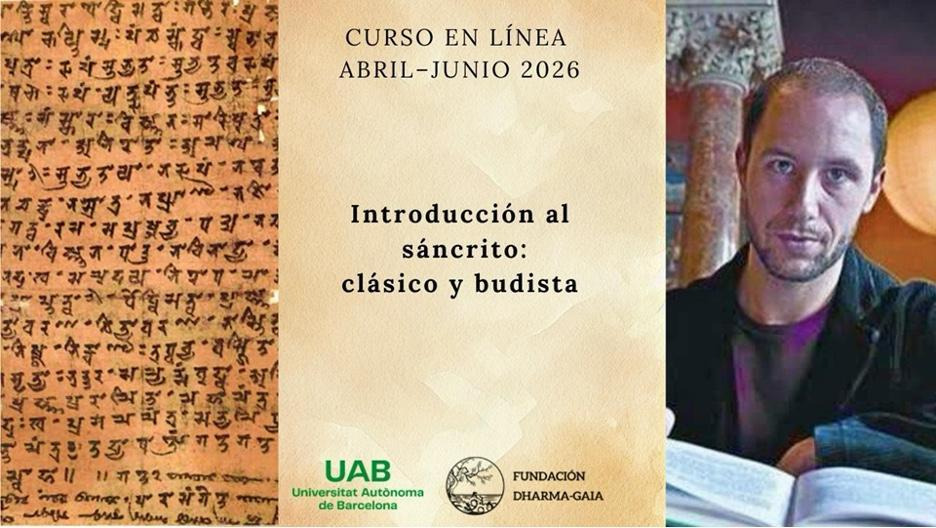
Study code: 5180/1
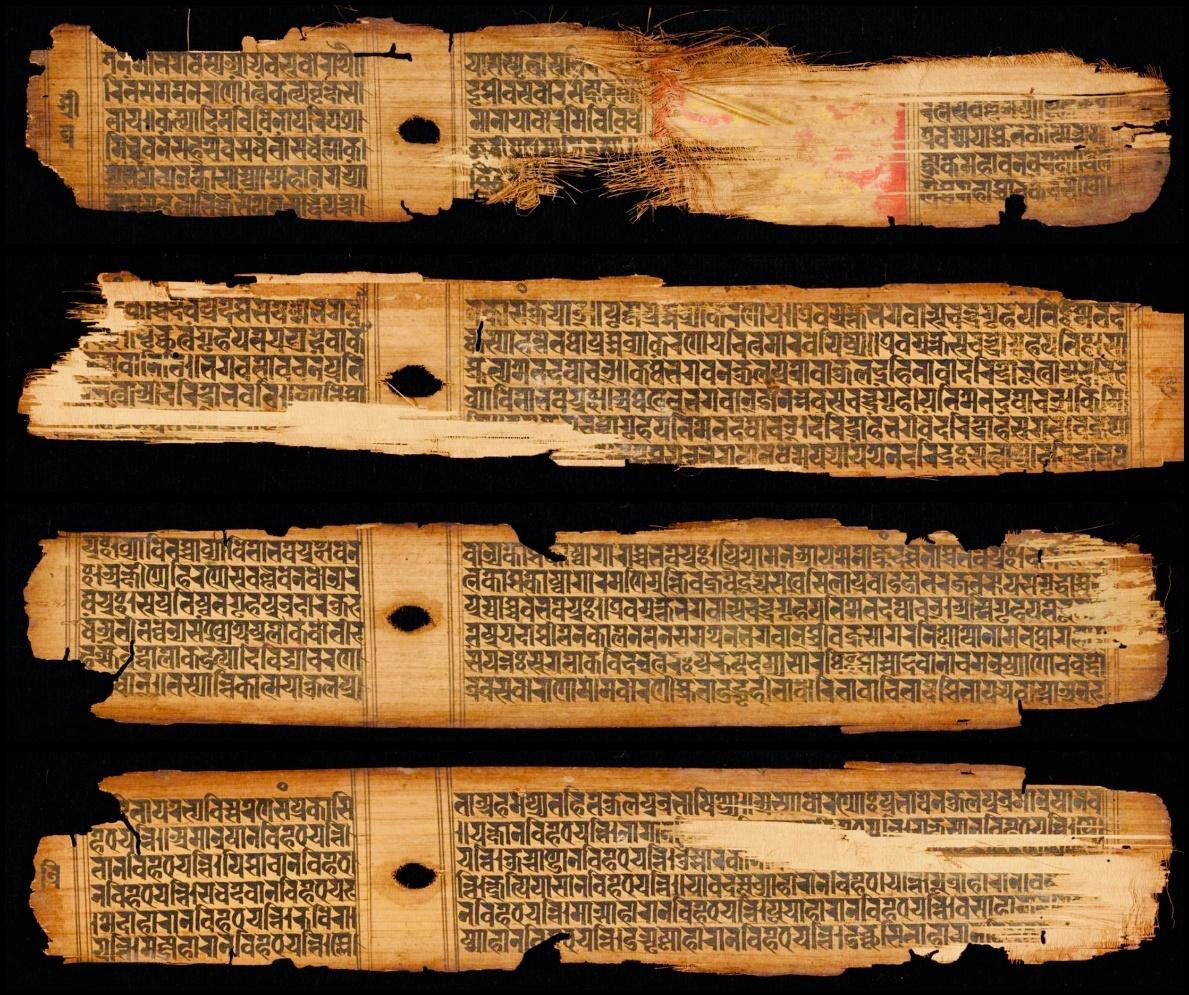
Description: Sanskrit is considered the most relevant classical language in Asia and the only truly shared language in cultural and spiritual terms across the continent. This course is designed for those who wish to explore and understand this fundamental language.
Teacher: Aleix Ruiz Falqués, doctor in Asian Studies from the University of Cambridge, with studies at the University of Pune and experience in Burma.
Contents:
- Introduction to the Sanskrit alphabet and writing Devanagari
- Sanskrit phonetic system and pronunciation rules
- Foundations of Sanskrit grammar
- Declination of nouns in their three genders
- Conjugation of verbs in the present tense
- Analysis of simple sentences
- Basic vocabulary of Buddhist texts
- Introduction to Buddhist Hybrid Sanskrit
Dates: From April 8 to July 1, 2026
Schedule: Monday and Wednesday from 17:00 to 18:00 (Barcelona time, Spain)
Modality: Completely online, with classes recorded through TEAMS and UAB Virtual Campus
Duration: 25 teaching hours (4 ECTS credits)
Seats: Maximum 30 (minimum 28)
Tuition price: 120 euros
Orientation: Academic and professional
Requirements: Have completed secondary education
For more information: Online Course: Introduction to Classical and Buddhist Sanskrit. Organized by the Dharma-Gaia Foundation and the Autonomous University of Barcelona
2. Online course: “Introduction to Pali language and literature: in-depth analysis of syntax and text reading (Pali III)”
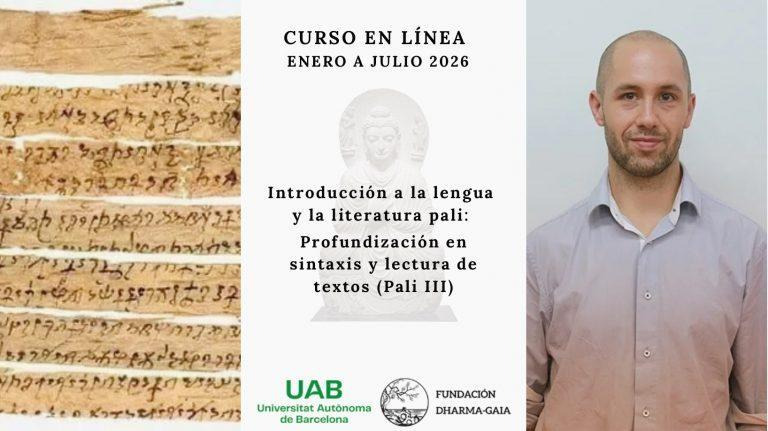
Study code: 5276/1
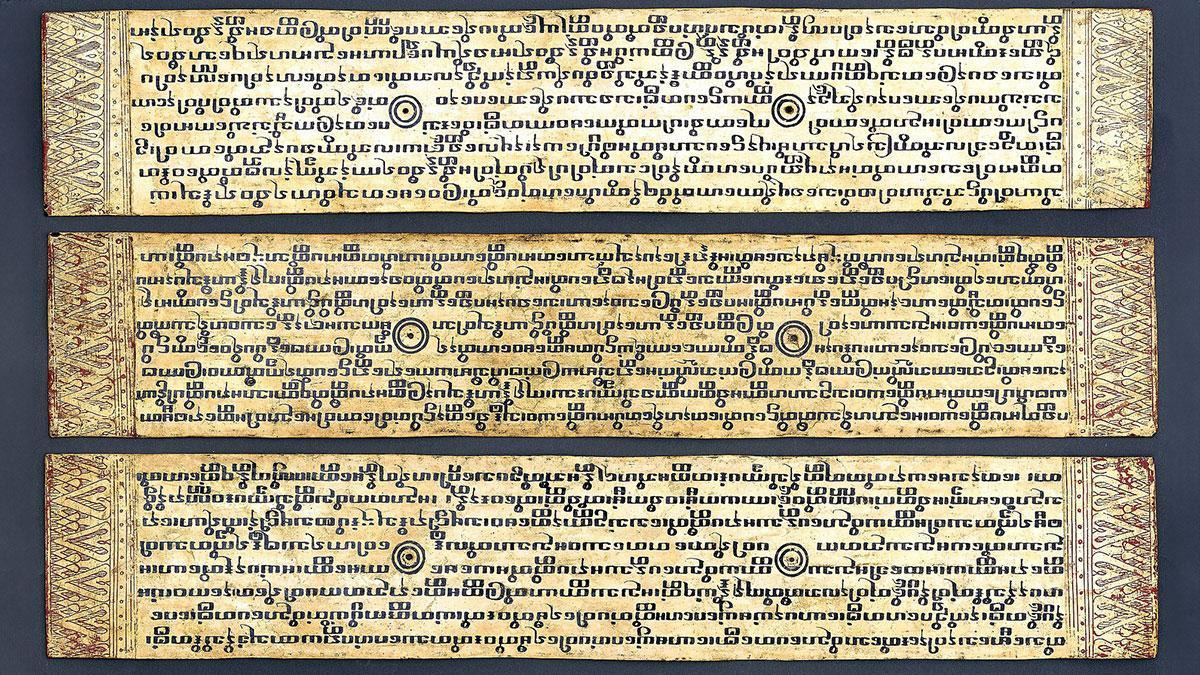
Description: Pali is the language of early Buddhist texts and constitutes an indispensable tool for those who wish to deepen the linguistic roots of Buddhism. This course is the third level of the comprehensive Pali study program offered by the Dharma-Gaia Foundation and the UAB.
Teacher: Aleix Ruiz Falqués, PhD in Asian Studies from the University of Cambridge, translator of works such as “In the Words of the Buddha” and “The Last Days of the Buddha”.
Contents:
- Deepening the Pali syntax
- Analysis of selected canonical texts from Dīgha Nikāya and Majjhima Nikāya
- Study of essential sutras such as Dhammacakkappavattana Sutta and Satipatthana Sutta
- Intensive practice of reading original texts
- Exploring Buddhist Teachings in Their Primal Context
- Analysis of complex nominal compounds
- Guided translation of passages from the Pali Canon
Dates: From January 9 to July 10, 2026
Schedule: a weekly session on Fridays from 17:00 to 18:00 (Barcelona time, Spain)
Modality: Completely online, with recorded classes
Duration: 25 teaching hours (4 ECTS credits)
Seats: Maximum 18 (minimum 15)
Tuition price: 120 euros
Orientation: Professional
Requirements: Prior knowledge of the Pali language (it is not essential to have studied Pali I and II, but it is recommended to have sufficient knowledge) and a certificate from secondary or higher education.
Scholarships: It is recommended to consult information on possibilities for scholarships and grants on the UAB scholarships, grants and calls page.
For more information: Online Course: “Introduction to Pali Language and Literature: Deepening Syntax and Text Reading (Pali III)”
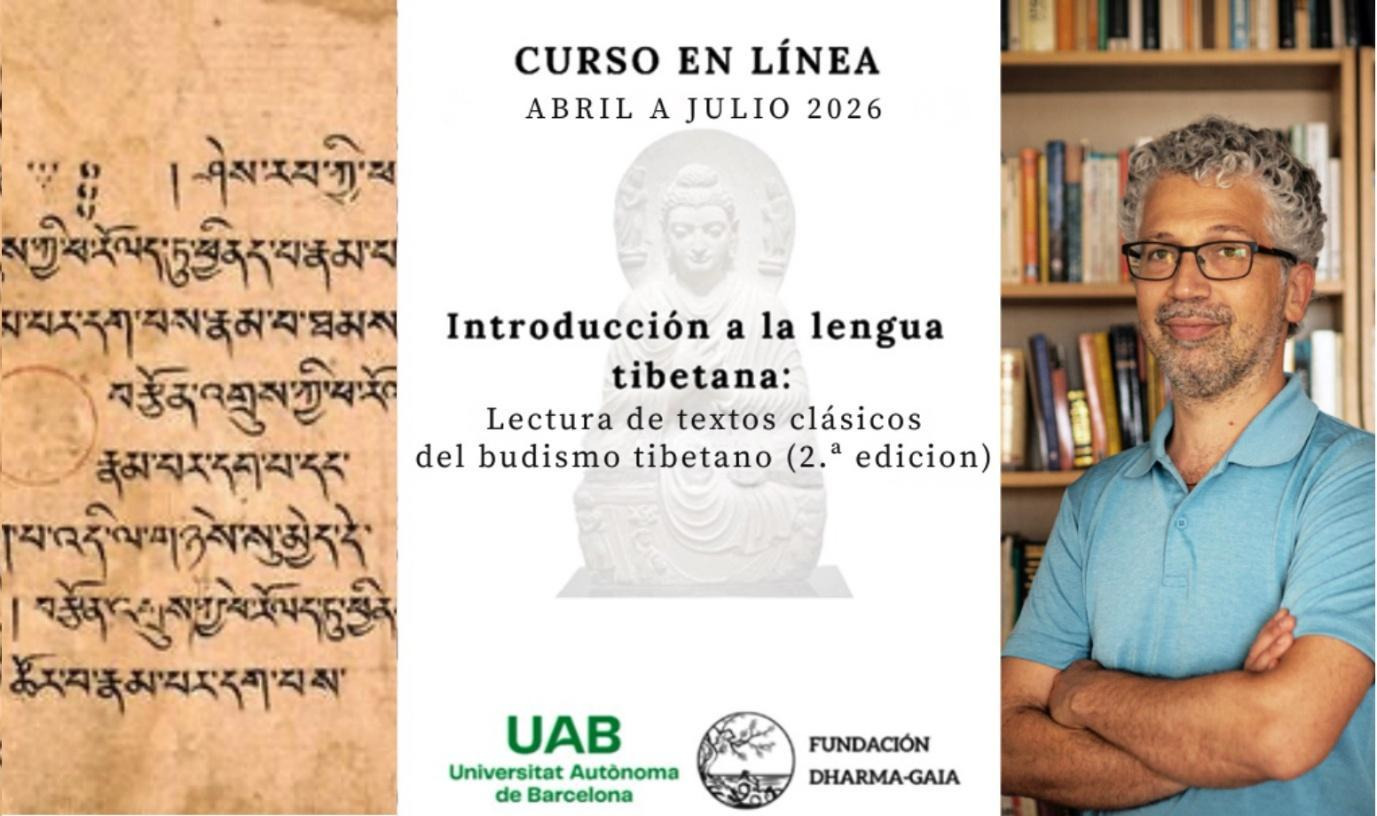
3. Online course: “Introduction to the classical Tibetan language: reading texts from Tibetan Buddhism (Tibetan I)”
Study code: 5268/1
Description: This course is the gateway to the vast literary universe of the Himalayas. It is designed to guide the student from the rudiments of writing to the understanding of basic syntactic structures, allowing direct access to one of the richest textual traditions in humanity. It is essential training for those who wish to approach the Tibetan Buddhist canon (Kangyur and Tengyur) with grammatical rigor and contextual sensitivity.
Teacher: Ferran Mestanza Garcia. Current Academic Director of the Dharma-Gaia Foundation and a specialist in Tibetology. Formed in the École Pratique des Hautes Études (Sorbonne) and the INALCO in Paris, have a solid teaching career in teaching classical Tibetan, combining academic philological rigor with a pedagogy adapted specifically for Spanish-speaking students.
Contents:
- The writing system: Learning the alphabet Uchen, spelling rules, ligatures and syllabic structure.
- Applied phonetics: Standard pronunciation applied to reading texts.
- Morphology and syntax: Study of grammatical particles, sentence structure and the functioning of verbs.
- Textual immersion: Reading and analysis of simple original texts and mantras.
- Specialized vocabulary: Key Dharma terminology and fundamental concepts of Tibetan Buddhism.
- Cultural context: Historical elements associated with the textual tradition of Tibet.
Practical data:
Dates: From April 7 to July 3, 2026
Schedule: Tuesday and Friday from 17:00 to 18:00 (Barcelona time, Spain)
Modality: Completely online, through the TEAMS platform
Duration: 25 teaching hours (4 ECTS credits)
Seats: Maximum 30
Tuition price: 120 euros
Orientation: Academic and professional, with an emphasis on Tibetological studies.
Requirements: Have completed secondary education.
Official Certification
At the end of any of the courses, students who have successfully completed them will receive an official certificate of achievement backed by the Autonomous University of Barcelona. This certificate will accredit the knowledge acquired during the course and will be a valuable recognition for those who wish to apply these studies in academic, cultural or professional fields.
Academic direction
- Gustavo Pita Céspedes
- Daniel Millet Gil
Enrollment Requirements
To formalize enrollment in any of the courses, interested parties must submit:
- A valid identity document
- A certificate of secondary or higher education
Continuity of the program
The complete Languages of Buddhism program offers continuity at the different levels of each language. The courses follow a logical progression that allows students to advance from the beginner level to the advanced level, where they can work with original Buddhist texts of greater complexity.
The higher levels (Sanskrit II-IV, Pali IV, and Tibetan II-IV) will address more advanced aspects such as:
- Reading and analysis of complete canonical texts
- Comparative study of different textual traditions
- Commentary analysis and exegetical literature
- Research on specific technical terms and philosophical concepts
- Translation of texts not previously translated into Spanish
Information about the opening of registrations for these levels will be communicated in a timely manner through our official channels.
Registrations
Enrollment forms are available at the following links:
Sanskrit Course I (Code 5180/1): Registration form
Pali III Course (Code 5276/1):Registration form
Tibetan Course I (Code 5268/1): Enrollment form
For any additional questions regarding the courses, the enrollment process or the requirements, do not hesitate to contact us:
- Contact: Gustavo Pita Céspedes
- Email: gustavo.pita@uab.cat
- Telephone: +34 93 586 8901
The FDG-UAB Buddhist Languages Program represents a unique opportunity in the Spanish-speaking world to access rigorous and systematic training in the classical languages of Buddhism. Through the study of these languages, participants will not only acquire valuable linguistic tools, but they will also immerse themselves in the philosophical, ethical and spiritual depths of one of humanity's most influential traditions of thought.
This program constitutes a comprehensive curriculum designed not only to develop competencies in reading and writing these ancient languages, but also to explore the literature, history and culture associated with each language. In this way, the student acquires a holistic vision of Buddhism that transcends mere linguistic knowledge, providing them with tools for a deep understanding of one of the most influential philosophical and spiritual traditions of humanity. This broad cultural approach distinguishes our training proposal and aligns it with the highest international standards in Buddhist studies
Don't miss this unique opportunity to explore the languages and traditions of Asia. We are waiting for you!

Useful links:
Faculty of Translation and Interpretation of the Autonomous University of Barcelona
Articles published in Buddhistdoor in Spanish
”The situation of Buddhist studies in Spain: educational programs” by Juan Arnau Navarro, Montse Castellà Olivé, Francisco Díez de Velasco, Ricardo Guerrero Diáñez, Basili Llorca Martínez, Daniel Millet Gil, Agustín Pániker Vilaplana, Aleix Ruiz Falqués, Jaume Vallverdú Vallverdú, Abraham Vélez de Cea.
”The expansion of Buddhist studies through the study of Pali: an interview with Aleix Ruiz Falqués” by Dipen Barua and Daniel Millet.
“The Dunhuang Diamond” by Aleix Ruiz-Falqués
”Ferran Mestanza: Teaching the Essence of Buddhism in the Modern World” by Daniel Millet.
Key Publications in Spanish-Speaking Buddhist Studies
Buddhist Studies in Latin America and Spain (Volume I), edited by Daniel Millet Gil and Jaume Vallverdú Vallverdú. This first volume brings together a series of essays that explore the relationship between Buddhism and Spanish-American culture, addressing issues such as the reception of Buddhism in Latin America and Spain, the translations of Buddhist texts into Spanish and the impact of Buddhism on contemporary societies.
Buddhist Studies in Latin America and Spain (Volume II), edited by Daniel Millet Gil and Jaume Vallverdú Vallverdú. The second volume expands the focus of the first, including contributions that analyze Buddhism from interdisciplinary and regional perspectives, with an emphasis on its interaction with local cultural traditions and its impact on the academic environment.
Both volumes are available in PDF format and can be downloaded free of charge through the following links First volume and Second volume


