

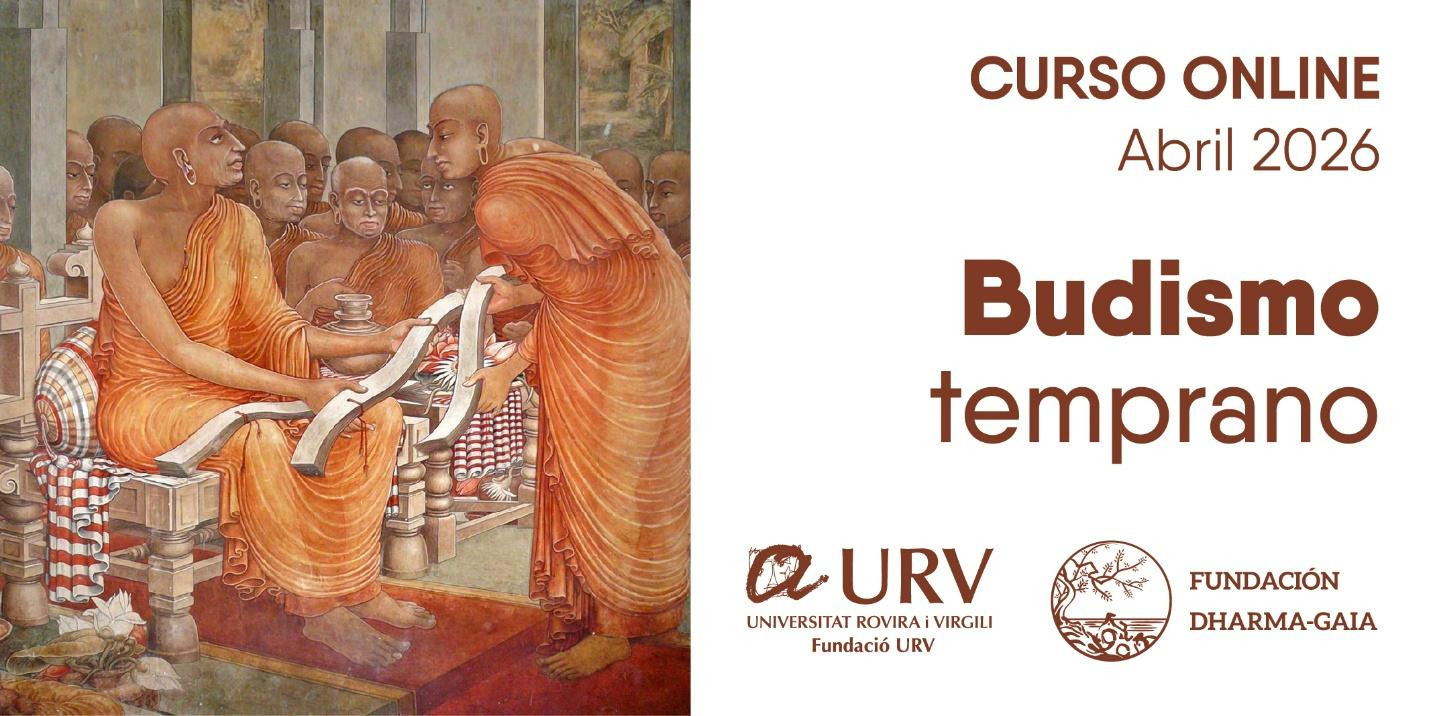
Open registrations: dates, format and enrollment
The Fundació Universitat Rovira i Virgili (FURV) and the Dharma-Gaia Foundation (FDG) have opened the registration period for the online course “Early Buddhism and the Theravāda Tradition: Teachings and Practices”. This training will be provided by April 7 to June 25, 2026, the Tuesday and Thursday from 16:00 to 18:30 (Spanish time), in full mode virtual. The sessions will be recorded and available during the academic period. The course has a limited space of 50 seats, which will be allocated in order of registration, with a tuition fee of 180 euros.
The official registration form is available on the URV Foundation website (see Early Buddhism and the Theravāda Tradition: Teachings and Practices). For inquiries about the enrollment process and administrative assistance, interested parties can contact Samantha Gascó Hernández through the mail samantha.gasco@fundacio.urv.cat. If you are interested in rigorous and applied training, this is the starting point! Reserve your place in advance to ensure your access to the sessions and to close teaching support.
Approach and Conception
This course is designed as a comprehensive and carefully guided journey through the doctrinal foundations, history and practice of early Buddhism, as well as the Theravāda tradition. The proposal combines three rare virtues in the same training experience: conceptual clarity with philological support, practical application and an institutional framework that guarantees academic continuity and seriousness, backed by an exceptional teaching staff. This means that you will study fundamental texts of primitive Buddhism under the guidance of experts, you will understand its philosophical structure and you will learn to integrate it into your meditative practice. We will also pay attention to ethics, the pace of learning and safety in practice, creating an environment conducive to your development.

Relevance of the study
The relevance of the object of study is based on both intellectual and practical reasons. Early Buddhism offers a detailed map of the human experience through fundamental concepts such as Dukkha (suffering), Anicca (impermanence) and Anatta (not me). These concepts relate to dependent origination, the Eightfold Path and the notion of Nibbana like a horizon of liberation. For its part, the Theravāda tradition preserves a canon in the Pali language and an exegesis of great sophistication, ranging from the Abhidhamma to commentaries and treatises such as Visuddhimagga. This allows access to Buddhist thought “from within”, using solid philological and hermeneutical criteria. The course proposes a gradual approach that balances study and practice, thus avoiding the risk of a decontextualized technique or theory without experiential application. In the end, it is sought that the participants not only understand the theory, but also to integrate it into their daily lives.
Framework program: four modules and certification
This course is part of the complete training program”Buddhism and its traditions: from its origins to its modern interpretations”, an academic itinerary structured in four modules that can be studied comprehensively or independently. The module that we are now presenting, dedicated to early Buddhism and the Theravāda tradition, constitutes the foundation of the program, since it establishes the conceptual vocabulary and the doctrinal bases on which the following are built. Subsequent modules explore the traditions of Mahāyāna (second module) and Vajrayāna (third module), culminating in a fourth module that analyzes contemporary reformulations of Buddhism in dialogue with science, psychology, ethics and various spheres of social life. This progressive structure allows both a panoramic understanding of the Buddhist phenomenon and an in-depth analysis of each of its main historical currents.
Learning structure
The learning experience is structured around three complementary axes that are intertwined throughout the course. El historical-contextual axis It places the life of the Buddha within the framework of ancient India and the currents Śramaṇa. This axis traces the first councils, the preservation of the teachings and presents the organization of the monastic community in relation to the lay community. El doctrinal axis rigorously explores the conceptual structure of early Buddhism, encompassing the Four Noble Truths, the three characteristics of existence, dependent origination, the Eightfold Path and the notion of Nibbana. Special attention is paid to the diversity of interpretations within the tradition. Eight classes will be dedicated to deepening the Theravāda tradition. Finally, the textual-practical axis combines guided readings of Suttas with meditation workshops, allowing participants to directly experience the teachings studied. This integration of theory and practice ensures meaningful and enriching learning.
Program in detail
The Buddha's Life: Context and Biography
The course program is developed over twenty-four sessions that follow a natural progression. During the month of April, Agustín Pániker Villaplana will guide participants through the life of the Buddha, starting with his historical context, birth and previous existences, to continue with his resignation and life as Śramaṇa, his awakening under the Bodhi tree, and ending with his work as a teacher, the organization of the first community and his Parinibbana. This biographical journey allows us to understand the rise of Buddhism in its original historical context.
The Teachings of Dharma
In late April and early May, the sessions will focus on Dharma, the doctrinal body of Buddhism. Agustín Pániker Villaplana will explore fundamental concepts such as Dukkha (dissatisfaction), Anicca (impermanence) and Anatta (not me), as well as Tanha (yearning), Kilesa (mental afflictions) and Avijja (ignorance). The structure of the human experience will also be studied through Khandas (aggregates), Paticca Samuppada (dependent origination) and Dream (emptiness). Subsequent sessions will address Bodhi (wake up), Kamma (action and its consequences), Samsara (cycle of rebirths), Nibbana (extinction of suffering), as well as the practical dimensions of the path: Magga (trail), Cloth (wisdom), Shila (ethics) and Samadhi (concentration).
The community and its historical development
The first part of the course will conclude with the study of the Sangha, the Buddhist community. The structure and operation of the Sangha monastic, including the order of nuns, as well as the role of Sangha layman. The first councils will be explored (Sangitis) that allowed the preservation and transmission of teachings, the development of Buddhism during the Mauryan empire, the division into 18 Nikayas (schools), the expansion of Buddhism across Asia and the causes of its decline in India. This historical tour will allow us to understand how Buddhism was transformed from a local movement to a pan-Asian tradition.
The Theravāda tradition: texts and doctrine
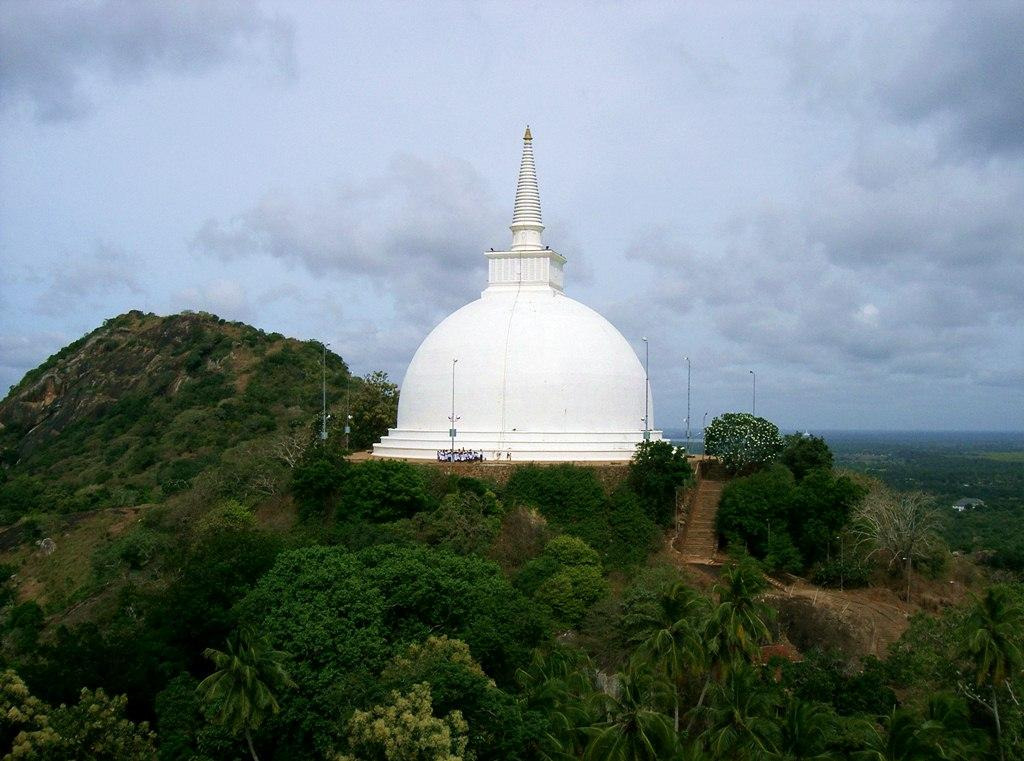
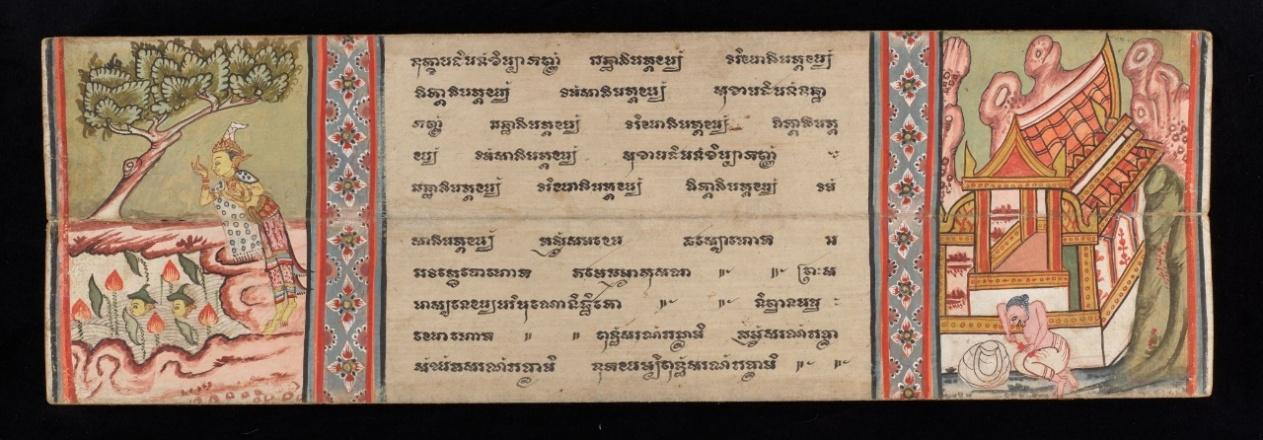
The second part of the course, led by Aleix Ruiz Falqués between May and June, will be specifically dedicated to the Theravāda tradition. Their position within early schools, their distinctive literature and their self-understanding as a preserver of the Buddha's original teaching will be examined. We will study the Kathāvatthu as the first articulation of a distinctly Theravāda doctrine and the characterization of this tradition as analytic Buddhism (Vibhajjavada). It will explore the Abhidhamma Theravāda compared to other abhidharmic systems and we will analyze the Milindapañha as a second fundamental doctrinal articulation. A significant space will be dedicated to the figure of Buddhaghosa, his life, legend and work, as well as to his predecessors in the Great Monastery (Mahāvihāra). Finally, the history of the Theravāda tradition in Sri Lanka during the second millennium and its expansion into Southeast Asia will be traced, showing how it became the dominant form of Buddhism in countries such as Thailand, Burma, Cambodia and Laos.
Practical meditation workshops
The course will culminate with four practical meditation workshops led by Bhikkhunī Arindama in June. These workshops will complement theoretical study with direct experience of the central contemplative practices of the Theravāda tradition. The first workshop will explore the fundamentals of the Eightfold Path as an ethical and practical framework for spiritual development. The second will focus on the four foundations for establishing mindfulness (Satipatthhana), the basis of vipassana meditation and the cornerstone of Theravāda contemplative practice. The third workshop will introduce the four Brahmaviharas or divine abodes: unconditional love (Put it on), compassion (Karuna), shared joy (Mudita) and equanimity (Upekkha), cultivating these qualities through guided practices. The cycle will conclude with a session dedicated to concentration (Samadhi) and an introduction to meditative absorptions (Jhanas), states of profound mental unification described in canonical texts.
Teaching methodology and formative evaluation
The teaching methodology is designed to balance conceptual understanding with practical experience. The classes include visual materials, glossaries, and outlines that help organize information without losing its complexity. The readings are accompanied by guides and questions that make it easier to identify key ideas, arguments and terms that are important in their context. Moderated discussion spaces promote a respectful and enriching exchange, where interpretations can be refined and critical analysis developed.
In meditation workshops, the instructions are clear and a gradual progression is followed, paying attention to common obstacles and offering strategies for self-regulation, ensuring that the practice is rigorous but also accessible. The evaluation is formative and includes personalized feedback on the final essay, as well as clear rubrics and support in choosing the topic and the necessary bibliography.
Admission requirements and final work
The admission requirements are simple and reasonable: it is requested to have completed secondary education and to have additional weekly hours of study, in addition to the synchronous schedule. Completion requires at least seventy percent of attendance—live or through review of recordings within the course period—and the delivery of a final essay of around two thousand words, integrating primary and secondary sources with clear arguments and careful references. The final work focuses on demonstrating understanding, ability to relate texts and clarity in the exhibition, instead of seeking a rhetorical virtuosity; guidance is provided for the choice of the topic, an annotated starting bibliography and a rubric that explains what is expected and how to improve.
Teaching team and academic management
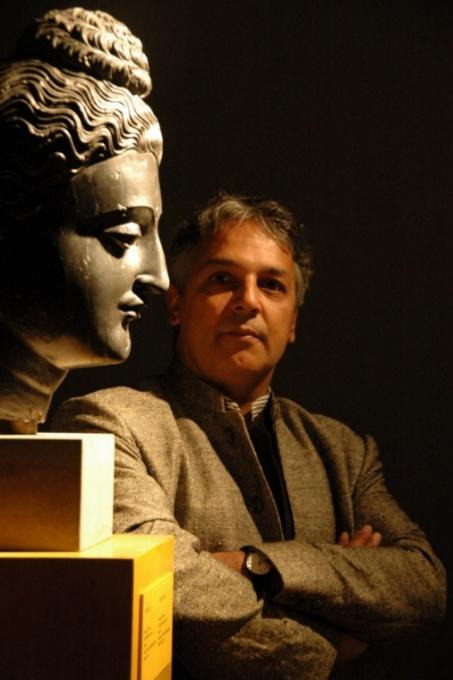
The teaching team provides an exceptional combination of academic experience and contemplative practice, under the academic direction of Jaume Vallverdú Vallverdú and Daniel Millet Gil. Agustín Pániker Vilaplana, director of the Kairós publishing house, professor in the master's degree in religions and societies at the Pablo Olavide University in Seville and author of numerous works on Asian religions, brings decades of study and dissemination of Eastern thought. Aleix Ruiz Falqués, PhD in South Asian Studies from the University of Cambridge and philologist specializing in Pali, offers an in-depth knowledge of canonical texts and their interpretation. Bhikkhunī Arindamā, the first fully ordained nun in Spain, with 25 years of experience in the study and practice of Buddhism, including training periods in Asia and the founding of the Saraṇa Vihāra monastery in Spain, provides the unique perspective of those who have dedicated their lives to embodying these teachings.
Recipients and benefits by profile
The course is designed to cater to a diverse audience but united by a serious interest in Buddhism. University students studying the humanities, philosophy or psychology will find a systematic conceptual framework and a carefully selected bibliography. Meditation practitioners interested in basing their practice will have contextualized instructions and a direct connection to canonical sources. Mental health and educational professionals will be able to evaluate judiciously the potential and limits of contemplative practices in contemporary contexts. To participate, no specific previous knowledge is required, only completed secondary education and a willingness for continued study.
Course logistics: campus, schedules and teaching load
From an operational point of view, the proposal is designed to facilitate participation and enjoyment, even if you can't always attend live. All sessions are recorded and are available during the academic period; the virtual campus centralizes links, materials, forums and the delivery of the essay with rubric; and the schedule is selected to be compatible with Latin America, maintaining the European university structure of credits and workload. The total duration is sixty hours, equivalent to six ECTS, with an approximate rate of five hours per week between synchronous sessions and autonomous study, a balance that allows depth without losing continuity.
Learning Outcomes
At the end of the course, participants will have acquired a clear conceptual vocabulary about early Buddhism and Theravāda, will develop fine-tuned criteria for interpreting Buddhist texts, will understand the historical evolution of this tradition and will have experienced first-hand its contemplative practices. Beyond the accumulation of information, the course seeks to cultivate a deeper look at texts, the world and the mind itself, consistent with the Buddhist invitation to see things “as they are”.
Registration and limited places
Registration is made using the form available on the URV Foundation website for the course “Early Buddhism and the Theravāda Tradition: Teachings and Practices”. The cost is 180€ and the space is limited to fifty people in order of registration, a decision that seeks to maintain the quality of the exchange and teaching care. Refund policies, and information about potential scholarships will be communicated before the start of the course. If you need administrative guidance, write to Samantha Gascó Hernández at samantha.gasco@fundacio.urv.cat to receive an agile and accurate response. Given the interest of these topics and the limited number of places, it is advisable to ensure early registration to plan your participation with peace of mind from the start.
Useful links:
Video presentation of the Universitat Rovira i Virgili 2020
Catalan Buddhist Film Festival
Articles published in Buddhistdoor in Spanish By or about course teachers
”Interview with Agustín Pániker, director of Editorial Kairós” by Daniel Millet.
”Saraṇa Vihāra: a refuge in the Montseny Massif” by Aleix Ruiz-Falqués
”The expansion of Buddhist studies through the study of Pali: an interview with Aleix Ruiz Falqués” by Dipen Barua and Daniel Millet.
”Presentation of the book In the words of the Buddha. An Anthology of Discourses from the Pali Canon, by Bhikkhu BodhI” by Caridad Martin Nieto.
Other related articles published on Buddhistdoor in Spanish
”The situation of Buddhist studies in Spain: educational programs” by Juan Arnau Navarro, Montse Castellà Olivé, Francisco Díez de Velasco, Ricardo Guerrero Diáñez, Basili Llorca Martínez, Daniel Millet, Agustín Pániker Vilaplana, Aleix Ruiz Falqués, Jaume Vallverdú Vallverdú, Abraham Vélez de Cea.
Buddhist Studies in Latin America and Spain (Volume I), edited by Daniel Millet Gil and Jaume Vallverdú Vallverdú. This first volume brings together a series of essays that explore the relationship between Buddhism and Spanish-American culture, addressing issues such as the reception of Buddhism in Latin America and Spain, the translations of Buddhist texts into Spanish and the impact of Buddhism on contemporary societies.
Buddhist Studies in Latin America and Spain (Volume II), edited by Daniel Millet Gil and Jaume Vallverdú Vallverdú. The second volume expands the focus of the first, including contributions that analyze Buddhism from interdisciplinary and regional perspectives, with an emphasis on its interaction with local cultural traditions and its impact on the academic environment.
Both volumes are available in PDF format and can be downloaded free of charge through the following links First volume and Second volume


